✈

Welcome to AME QUESTION PAPER

Sign in to access your study materials, mock tests and more.

Login with Google

Sign in with Google. New users get an account automatically.

G Sign up with Google

New user? Create your account with Google.

Login / Sign Up with Email

✈
AME QUESTION PAPER
www.amequestionpaper.in
Skip to content
✈ India's AME Exam Preparation Platform Serving AME Students Since 2017
WhatsApp Support Contact
AME Question Paper
Home
📘 DGCA Question Papers Previous papers & short notes ⭐ Premium Study Material Premium DGCA AME modules 📚 AME Reference Books Recommended reference material 🌐 EASA Papers & Notes EASA examination resources
Mock Tests RTR(A) Jobs News Blogs
Premium Login
Login / Sign Up Home DGCA Question Papers & Notes Premium Study Material Premium Mock Tests AME Reference Books RTR(A) Aviation Jobs Aviation News Blogs

Why Aluminum is Used to Build Airplanes

November 20, 2026
in Blogs
A A

27% of all aluminum consumed occurs in the transportation industry, according to Aluminum Leader. This chemical element in the boron group is characterized by a silver-white color and soft, ductile texture. While it’s used in many different applications, one of the most common is aerospace. In fact, aluminum is one of the most common materials used in the construction of airplanes. So, why is aluminum used for this purpose instead of steel or other materials?

Some of the first airliners weren’t made of metal, but instead were made of wood. Although cheap and readily available, wood has a serious flaw that made it hazardous in airplanes: it rotted. There was one instances in which a wooden airliner crashed, killing everyone on board. The cause of the crash was later found to be rotten wood. This prompted manufacturers to quickly phase out wood in favor of metal.

Aluminum is the perfect material to use when manufacturing airplanes, thanks in part to its unique properties and characteristics. It’s strong, lightweight, predictable and inexpensive. Steel and iron are both stronger than aluminum, but strength alone isn’t enough to justify its use in aerospace manufacturing. The problem with steel and iron is its weight. Both of these metals are much heavier than aluminum — and too much weigh restricts an airplane’s ability to takeoff and fly.

It’s estimated that up to 80% of the materials used in modern-day aircraft is aluminum. The Wright brothers used a steel engine in their early-model Flyer plane, which was not only heavy but lacked the power necessary for takeover. As a result, they acquired a special engine made of cast aluminum, which allowed their Flyer-1 to takeoff with ease.

There are several different types of aluminum used in aerospace engineering, some of which include the following:

  • Aluminum 2024
  • Aluminum 3003
  • Aluminum 5052
  • Aluminum 6061
  • Aluminum 7075

Note: the number refers to the aluminum’s “grade.”

Of course, aluminum isn’t the only metal used to manufacture airplanes. Carbon-alloy steel is often used for his application as well. When carbon is added to steel, it becomes stronger and more resistant to rust and corrosion. Titanium is another metal that’s commonly used in aerospace engineering. It’s strong, lightweight, and naturally resistant to corrosion. Some companies alloy titanium with iron or manganese to construct the frame and engines for airplanes. These use of these metals, however, is typically less than that of aluminum. Aluminum isn’t the strongest metal, but it maintains a perfect balance of strength and low weight that make it ideal for airplanes.
Related Posts

AMOS APN Finder
Blogs

AMOS APN Finder

November 20, 2026
MEL Calculator
Blogs

MEL Calculator

November 20, 2026
Blogs

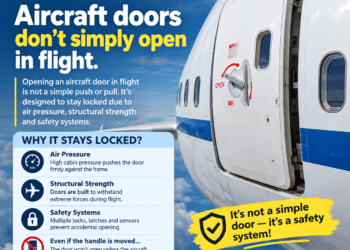
WHY DON’T AIRCRAFT DOORS SIMPLY OPEN IN FLIGHT?

November 20, 2026
Why airplane windows have tiny holes?
Blogs

Why airplane windows have tiny holes?

November 20, 2026
Why airplane windows have tiny holes?
Blogs

Why Your Ears Pop When Flying in an Airplane

November 20, 2026
How the Wings of an Airplane Generate Lift
Blogs

How the Wings of an Airplane Generate Lift

November 20, 2026

Preparing for DGCA AME exams?

Previous year papers, B1 & B2 notes and DGCA-pattern mock tests – all in one place.

Take a Mock Test DGCA Question Papers & Notes
AME QUESTION PAPER

India's first online platform for AME candidates, serving students since 2017 with quality study material for DGCA and EASA exams.

11,75,112 Global visitors
Since 2017 Serving AME students

Study Resources

  • DGCA Papers & Notes
  • Mock Tests
  • EASA Papers & Notes
  • AME Reference Books
  • RTR(A) Classes
  • Members' Results

Quick Links

  • Home
  • About Us
  • Aviation Jobs
  • Aviation News
  • Blogs
  • My Dashboard

Help & Policies

  • Contact Us
  • Terms & Conditions
  • Privacy Policy
  • Refunds & Cancellations
  • Disclaimer

Get in Touch

  • WhatsApp Support +91 75593 69412
  • Support support@amequestionpaper.in
© 2017–2026 AME QUESTION PAPER. All rights reserved. Design by AME QUESTION PAPER ❤

Ok

Create New Account!

Fill the forms below to register

All fields are required. Log In

Retrieve your password

Please enter your username or email address to reset your password.

Log In
✈
AME QUESTION PAPER Support www.amequestionpaper.in
Hi! 👋 How can we help with your DGCA Exam Preparation?
What do you need help with?
DGCA QUESTION PAPERSMOCK TESTRTR(A) CLASSESGUIDANCE
Start WhatsApp Chat WhatsApp Support: +91 75593 69412
No Result
View All Result
  • Home
  • AME
    • DGCA QUESTION PAPER & NOTES
    • MOCK TEST
    • AME REFERENCE BOOKS
    • EASA QUESTION PAPER & NOTES
  • RTR
  • JOBS
  • News
  • Blogs
  • Login
  • Sign Up

Copyright 2017-2026 © All rights Reserved. Design by AME QUESTION PAPER ❤

Insert/edit link

Enter the destination URL

Or link to existing content

    No search term specified. Showing recent items. Search or use up and down arrow keys to select an item.