



Category
A
Line
Maintenance
Minor scheduled line maintenance and simple defect rectification within authorised tasks.
- A1 Aeroplanes · Turbine
- A2 Aeroplanes · Piston
- A3 Helicopters · Turbine
- A4 Helicopters · Piston

A clear, regulation-based guide to the DGCA licensing pathway, licence categories, basic modules, experience requirements, type ratings and career scope in aircraft maintenance.
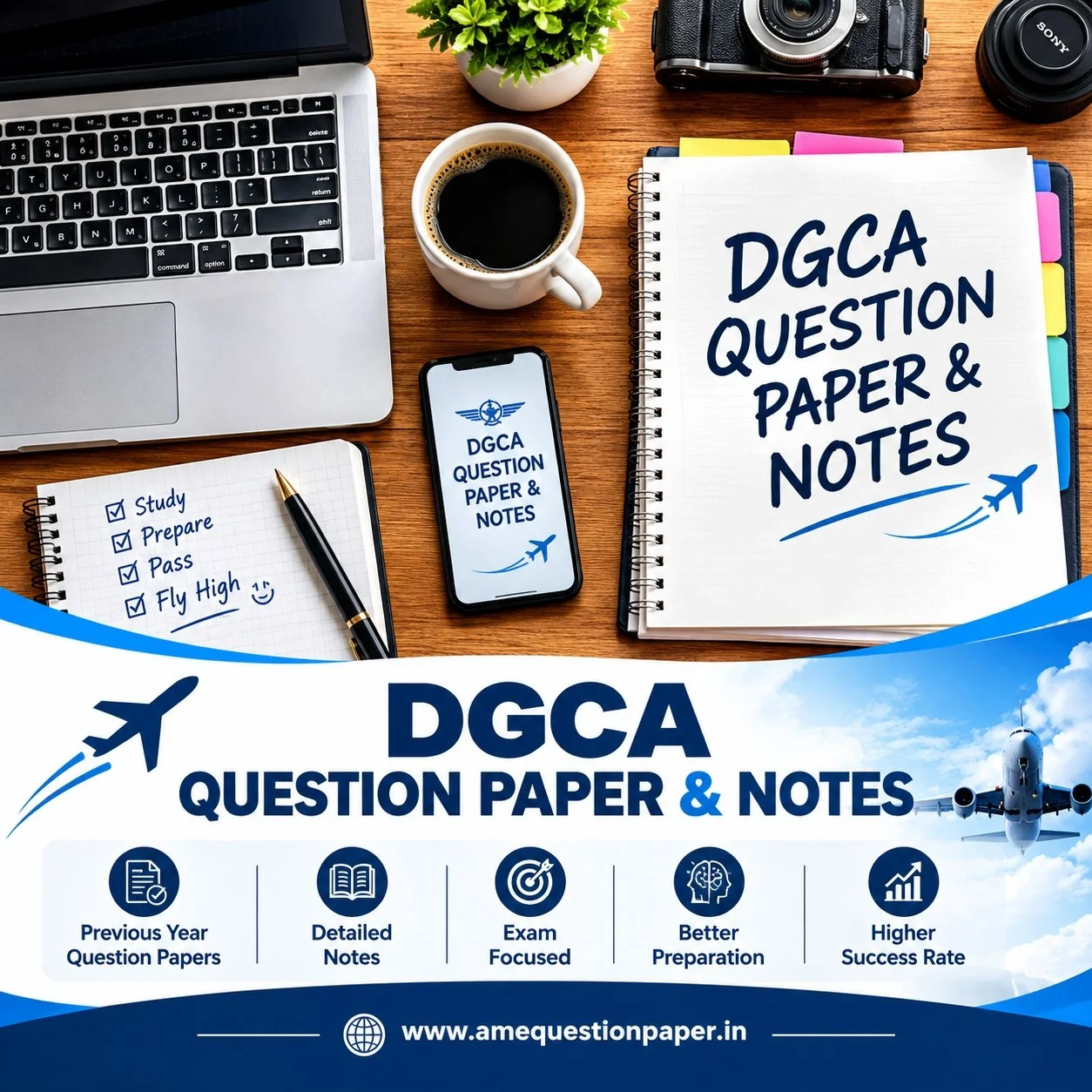
Question papers, notes, mock tests and reference books, all in one place.
An AME licence is a regulatory qualification for aircraft maintenance certification. Depending on the licence category, the holder may certify specified maintenance and issue a Certificate of Release to Service within the privileges and aircraft ratings endorsed on the licence.
AME work includes inspection, troubleshooting, repair, replacement, testing and certification tasks performed under approved maintenance data and organisation procedures.
A course or engineering degree can support the licensing route, but DGCA licensing also depends on the applicable knowledge examinations, practical maintenance experience, skill requirements and aircraft rating requirements.
The licence eligibility below follows CAR-66. Institute admission rules can be different and should not be confused with DGCA licence eligibility.
Your licence category determines the maintenance privileges and the applicable CAR-66 knowledge requirements.
Minor scheduled line maintenance and simple defect rectification within authorised tasks.
Aircraft structure, powerplant, mechanical and electrical systems, plus limited avionics tasks using simple tests.
Avionic and electrical systems, including eligible avionics/electrical tasks within powerplant and mechanical systems.
The 2025 revision reserves Modules 1 and 2. The applicable module matrix depends on the licence category/subcategory.
Names below follow the current CAR-66 modularisation matrix. Exact question counts and duration vary by category and module.
Five regulatory stages from eligibility to aircraft-specific certification privileges.
There is no single universal “2 years + 2 years” or “4-year practical experience” route in CAR-66. Required experience varies by licence category and by the applicant’s recognised training or degree pathway.
Confirm academic eligibility and the CAR-66 minimum licence-applicant age requirement.
Study the modules applicable to the intended licence category or subcategory.
Clear the required CAR-66 basic knowledge examinations within the applicable validity window.
Accumulate documented aircraft maintenance experience on operating aircraft as required by 66.A.30.
Complete the applicable type training, aircraft rating and OJT requirements before exercising aircraft-specific privileges.
The answer depends on licence category and previous recognised technical training.
| Licence category | No previous relevant technical training | Recognised engineering / aircraft-maintenance degree | Approved basic aircraft maintenance training under Rule 133B |
|---|---|---|---|
| A, B1.2, B1.4, B3 | 3 years | 2 years | 1 year |
| B1.1, B1.3, B2 | 5 years | 3 years | 2 years |
| B2L | 3 years, covering the relevant system rating | 2 years, covering the relevant system rating | 1 year, covering the relevant system rating |
Privileges are not unlimited. They depend on the licence category, aircraft rating, competence, current experience and the maintenance organisation’s authorisation.
Release-to-service and support-staff privileges for maintenance on aircraft structure, powerplant, mechanical and electrical systems, plus avionics work requiring only simple tests and no troubleshooting, for aircraft types endorsed on the licence.
Release-to-service and support-staff privileges after maintenance on avionics and electrical systems, plus specified avionics/electrical tasks within powerplant and mechanical systems. B2 does not automatically include an A subcategory.
To exercise certification privileges on a specific aircraft type, the relevant aircraft rating must be endorsed where CAR-66 requires it. For the first aircraft type rating within a category/subcategory, OJT is required for licences other than Category C, subject to the detailed rules and exceptions in CAR-66.
For B1, B2 or C aircraft type ratings, CAR-66 requires the relevant approved type-training route or the alternative type-examination route where permitted for Group 2/3 aircraft.
OJT is performed in an appropriately approved maintenance environment, documented in an OJT logbook and supervised by qualified mentors. At least 50% of OJT tasks must occur after completion of the related theoretical type training.
FIAME describes the AME route as a combination of theoretical knowledge and practical training leading toward DGCA licensing. Typical employers and work environments include:
Use previous-year questions, topic-wise notes and DGCA-pattern mock tests alongside the official CAR-66 syllabus.