
✈

Welcome to AME QUESTION PAPER

Sign in to access your study materials, mock tests and more.

Login with Google

Sign in with Google. New users get an account automatically.

G Sign up with Google

New user? Create your account with Google.

Login / Sign Up with Email

✈
AME QUESTION PAPER
www.amequestionpaper.in
Skip to content
✈ India's AME Exam Preparation Platform Serving AME Students Since 2017
Premium Study Material WhatsApp Support Contact
AME Question Paper
Home
📘 DGCA Question Papers Previous papers & short notes ⭐ Premium Study Material Premium DGCA AME modules 📚 AME Reference Books Recommended reference material 🌐 EASA Papers & Notes EASA examination resources
Mock Tests RTR(A) Jobs News Blogs
⌕ Login / Sign Up
Premium Study Material
Home 📘 DGCA Question Papers & Notes ⭐ Premium Study Material 🎯 Premium Mock Tests 📚 AME Reference Books 🎙 RTR(A) 💼 Aviation Jobs 📰 Aviation News ✍ Blogs Login / Sign Up

What Is a Transponder and Why Do Airplanes Use Them?

May 7, 2022
in Blogs
A A
What Is a Transponder and Why Do Airplanes Use Them?

A transponder is a common device that’s found on most airplanes. In the United States, most airplanes are required to have one. The only exception is non-electrical aircraft that fly at an altitude below 10,000 feet, such as balloons and gliders. What is a transponder exactly, and why do airplanes use them?

The Basics of Transponders and How They Work

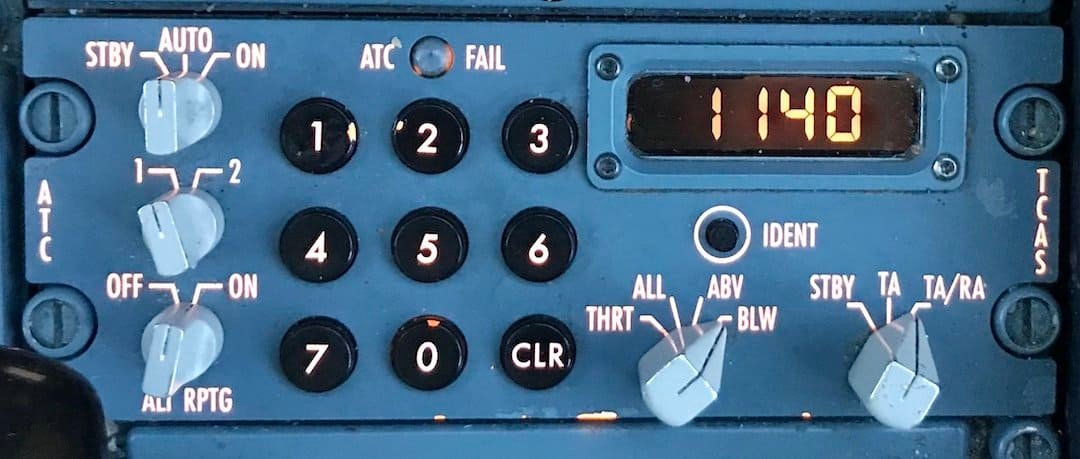
A transponder is a device that emits an air-based signal upon the reception of a signal from the ground. Also known as an XPDR, TPDR and TP, it’s used to help air traffic controllers locate airplanes. Air traffic controllers can send a radio-frequency signal to an airplane, at which point the airplane’s transponder will respond with its location. Air traffic controllers can then use this information to determine where the airplane is located almost instantly.

At any given time, there are around 10,000 to 20,000 airplanes in the air. To prevent midair collisions, as well as other accidents, air traffic controllers must keep an eye on where these airplanes are located. If two airplanes are approaching each other, air traffic controllers can contact their respective pilots to direct a change of course.

Air traffic controllers work from ground-based stations, such as towers. At these stations are radars that communicate with airplanes and their transponders. Air traffic controllers can send a signal to an airplane, and the airplane’s transponder will respond with its location and squawk code (see below).

The ‘Squawk’ Code

Transponders work in conjunction with a squawk code. A squawk code is a unique identifier that associates a transponder with an airplane. Prior to taking off, pilots must enter the squawk code so that air traffic controllers can identify them.

Each flight has a squawk code. When replying to air traffic controllers, the transponder will send the airplane’s location and its squawk code. Squawk codes are important because they allow air traffic controllers to identify specific flights. If an airplane doesn’t have a squawk code, they won’t know which flight it is. Air traffic controllers may receive its location, but the squawk code is ultimately what identifies airplanes in the air.

In Conclusion

A transponder is a small device that receives and sends radio signals. It’s used to tell air traffic controllers the flight and location of an airplane. With this information, air traffic controllers can better manage the tens of thousands of airplanes in the air to prevent accidents from occurring.
Related Posts

AMOS APN Finder
Blogs

AMOS APN Finder

November 11, 2026
MEL Calculator
Blogs

MEL Calculator

October 16, 2026
Blogs

WHY DON’T AIRCRAFT DOORS SIMPLY OPEN IN FLIGHT?

September 7, 2026
Why airplane windows have tiny holes?
Blogs

Why airplane windows have tiny holes?

September 7, 2026
Why airplane windows have tiny holes?
Blogs

Why Your Ears Pop When Flying in an Airplane

September 7, 2026
How the Wings of an Airplane Generate Lift
Blogs

How the Wings of an Airplane Generate Lift

September 7, 2026

Preparing for DGCA AME exams?

Previous year papers, B1 & B2 notes and DGCA-pattern mock tests – all in one place.

Take a Mock Test DGCA Question Papers & Notes
AME QUESTION PAPER

India's first online platform for AME candidates, serving students since 2017 with quality study material for DGCA and EASA exams.

11,75,112 Global visitors
Since 2017 Serving AME students

Study Resources

  • DGCA Papers & Notes
  • Mock Tests
  • EASA Papers & Notes
  • AME Reference Books
  • RTR(A) Classes
  • Members' Results

Quick Links

  • Home
  • About Us
  • Aviation Jobs
  • Aviation News
  • Blogs
  • My Dashboard

Help & Policies

  • Contact Us
  • Terms & Conditions
  • Privacy Policy
  • Refunds & Cancellations
  • Disclaimer

Get in Touch

  • WhatsApp Support +91 75593 69412
  • Support support@amequestionpaper.in
© 2017–2026 AME QUESTION PAPER. All rights reserved. Design by AME QUESTION PAPER ❤

Ok

Create New Account!

Fill the forms below to register

All fields are required. Log In

Retrieve your password

Please enter your username or email address to reset your password.

Log In
✈
AME QUESTION PAPER Support www.amequestionpaper.in
Hi! 👋 How can we help with your DGCA Exam Preparation?
What do you need help with?
DGCA QUESTION PAPERSMOCK TESTRTR(A) CLASSESGUIDANCE
Start WhatsApp Chat WhatsApp Support: +91 75593 69412
No Result
View All Result
  • Home
  • AME
    • DGCA QUESTION PAPER & NOTES
    • MOCK TEST
    • AME REFERENCE BOOKS
    • EASA QUESTION PAPER & NOTES
  • RTR
  • JOBS
  • News
  • Blogs
  • Login
  • Sign Up

Copyright 2017-2026 © All rights Reserved. Design by AME QUESTION PAPER ❤

Insert/edit link

Enter the destination URL

Or link to existing content

    No search term specified. Showing recent items. Search or use up and down arrow keys to select an item.