
✈

Welcome to AME QUESTION PAPER

Sign in to access your study materials, mock tests and more.

Login with Google

Sign in with Google. New users get an account automatically.

G Sign up with Google

New user? Create your account with Google.

Login / Sign Up with Email

✈
AME QUESTION PAPER
www.amequestionpaper.in
Skip to content
✈ India's AME Exam Preparation Platform Serving AME Students Since 2017
WhatsApp Support Contact
AME Question Paper
Home
📘 DGCA Question Papers Previous papers & short notes ⭐ Premium Study Material Premium DGCA AME modules 📚 AME Reference Books Recommended reference material 🌐 EASA Papers & Notes EASA examination resources
Mock Tests RTR(A) Jobs News Blogs
Premium Login
Login / Sign Up Home DGCA Question Papers & Notes Premium Study Material Premium Mock Tests AME Reference Books RTR(A) Aviation Jobs Aviation News Blogs

Why Airplane Tires Are Made of Conductive Rubber

November 20, 2026
in Blogs
A A
How the Wings of an Airplane Generate Lift

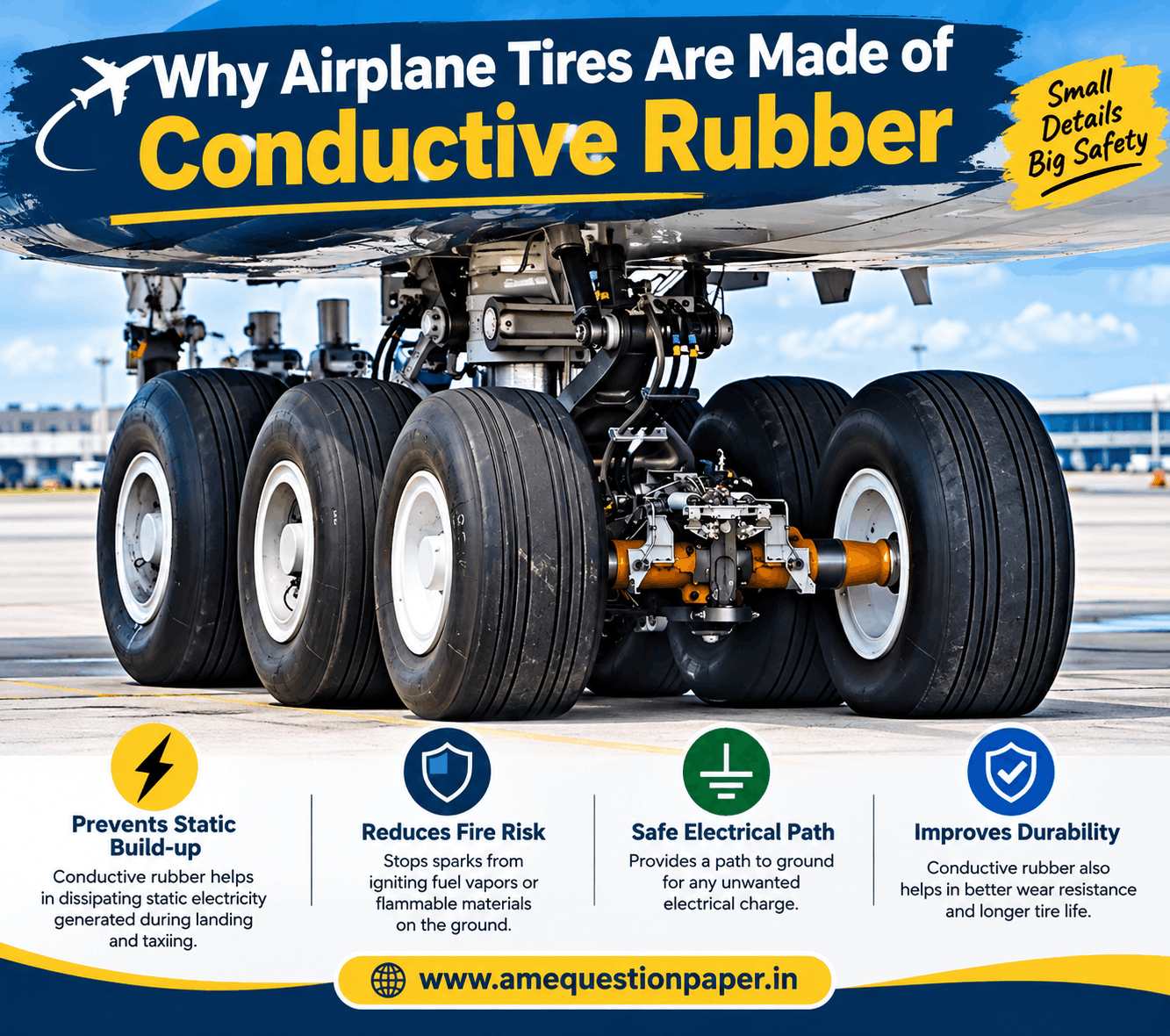
Tires are an essential component of an airplane’s landing system. Airplanes can’t land on the belly of their fuselage. Rather, they must land on inflated tires that can withstand both the weight of the airplane and the friction it creates on the runway. Some airplanes contain four or six tires, whereas others contain up to 10 tires. With tires, airplanes can safely take off and land.

With that said, airplanes don’t use the same rubber tires as cars, trucks and other road vehicles. They may look similar, but airplane tires are made of a special type of rubber that’s not found in automotive tires. Known as conductive rubber, this alternative material distinguishes airplane tires from automotive tires. So, why are airplane tires made of conductive rubber instead of traditional rubber?

What Is Conductive Rubber?

Conductive rubber is an elastic rubber-based material that’s designed specifically to conduct electricity. Also known as conductive elastomer, electricity can flow through it with minimal restriction. Conductivity, of course, is a measurement of how well electricity can flow through a material or object. Some materials high excellent conductivity, whereas others have poor conductivity. Conductive rubber is simply any type of rubber-based material through which electricity can easily flow.

The Reason Airplanes Use Conductive-Rubber Tires

Airplanes use tires made of conductive rubber to neutralize electricity. Electricity is created naturally through friction — and airplane tires are exposed to a lot of friction during takeoffs and landings. The friction between an airplane’s tires and the runway can lead to a buildup of electricity. When taking off, an airplane’s tires may accumulate electricity that can damage the airplane’s electronic components.

Airplanes contain hundreds if not thousands of electrical components, many of which are highly sensitive to electrical discharge. If a stray electrical charge reaches one of these components, the component may fail. The use of conductive rubber tires prevents this from happening.

Even though conductive rubber allows electricity to flow through it, it prevents the buildup of electricity. With conductive rubber tires, electricity will travel to the ground rather than accumulating in the tires. The friction-created electricity won’t build up in the airplane’s tires. When made of conductive rubber, the tires will expel it to the ground.

In Conclusion

Conductive rubber is the preferred choice of material used in the production of airplane tires. It features the same force-absorbing properties as traditional rubber but with the added benefit of conductivity. Conductive rubber tires protect an airplane’s electronics from damage caused by electrical discharge.

Related Posts

AMOS APN Finder
Blogs

AMOS APN Finder

November 20, 2026
MEL Calculator
Blogs

MEL Calculator

November 20, 2026
Blogs

WHY DON’T AIRCRAFT DOORS SIMPLY OPEN IN FLIGHT?

November 20, 2026
Why airplane windows have tiny holes?
Blogs

Why airplane windows have tiny holes?

November 20, 2026
Why airplane windows have tiny holes?
Blogs

Why Your Ears Pop When Flying in an Airplane

November 20, 2026
How the Wings of an Airplane Generate Lift
Blogs

How the Wings of an Airplane Generate Lift

November 20, 2026

Preparing for DGCA AME exams?

Previous year papers, B1 & B2 notes and DGCA-pattern mock tests – all in one place.

Take a Mock Test DGCA Question Papers & Notes
AME QUESTION PAPER

India's first online platform for AME candidates, serving students since 2017 with quality study material for DGCA and EASA exams.

11,75,112 Global visitors
Since 2017 Serving AME students

Study Resources

  • DGCA Papers & Notes
  • Mock Tests
  • EASA Papers & Notes
  • AME Reference Books
  • RTR(A) Classes
  • Members' Results

Quick Links

  • Home
  • About Us
  • Aviation Jobs
  • Aviation News
  • Blogs
  • My Dashboard

Help & Policies

  • Contact Us
  • Terms & Conditions
  • Privacy Policy
  • Refunds & Cancellations
  • Disclaimer

Get in Touch

  • WhatsApp Support +91 75593 69412
  • Support support@amequestionpaper.in
© 2017–2026 AME QUESTION PAPER. All rights reserved. Design by AME QUESTION PAPER ❤

Ok

Create New Account!

Fill the forms below to register

All fields are required. Log In

Retrieve your password

Please enter your username or email address to reset your password.

Log In
✈
AME QUESTION PAPER Support www.amequestionpaper.in
Hi! 👋 How can we help with your DGCA Exam Preparation?
What do you need help with?
DGCA QUESTION PAPERSMOCK TESTRTR(A) CLASSESGUIDANCE
Start WhatsApp Chat WhatsApp Support: +91 75593 69412
No Result
View All Result
  • Home
  • AME
    • DGCA QUESTION PAPER & NOTES
    • MOCK TEST
    • AME REFERENCE BOOKS
    • EASA QUESTION PAPER & NOTES
  • RTR
  • JOBS
  • News
  • Blogs
  • Login
  • Sign Up

Copyright 2017-2026 © All rights Reserved. Design by AME QUESTION PAPER ❤

Insert/edit link

Enter the destination URL

Or link to existing content

    No search term specified. Showing recent items. Search or use up and down arrow keys to select an item.