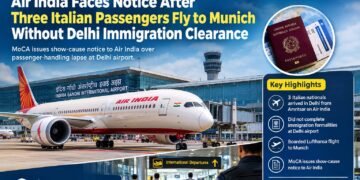




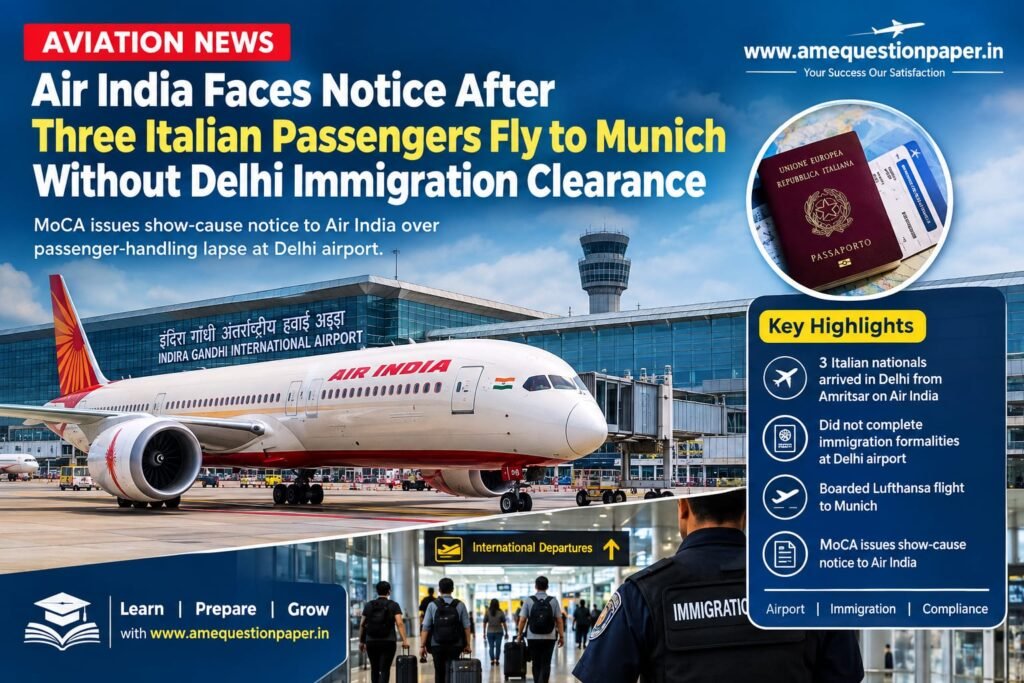
New Delhi: Air India is facing regulatory scrutiny after three Italian nationals reportedly travelled from Amritsar to Delhi and subsequently boarded an international flight to Munich without completing the mandatory immigration process at Indira Gandhi International Airport.
The incident, which occurred on September 4, 2026, has raised concerns about passenger-handling procedures, immigration compliance and coordination between airlines and airport authorities. The Ministry of Civil Aviation (MoCA) has issued a show-cause notice to Air India seeking an explanation for the alleged procedural lapse.
What Happened at Delhi Airport?
According to reports, the three Italian passengers arrived in Delhi on Air India flight AI-1115 from Amritsar at approximately 00:50 hours on September 4.
They were subsequently scheduled to travel from Delhi to Munich on Lufthansa flight LH-763, which departed at around 01:45 hours.
The passengers reportedly received boarding passes for both sectors at Amritsar. However, after arriving at Delhi, they did not complete the immigration formalities required before leaving India.
Instead, they were reportedly directed towards an international transfer area and eventually boarded the Lufthansa flight to Munich.
Why Was Immigration Clearance Required?
The passengers’ journey was reportedly not covered by the Air India Hub-and-Spoke procedure that permits certain passengers to complete immigration at their originating airport.
In a normal domestic-to-international connection of this type, passengers arriving domestically at Delhi would be required to exit through the appropriate arrival process and complete departure immigration before proceeding to the international departure area.
The reported failure to complete this mandatory process is therefore being treated as a significant procedural and security concern.
Why Did Air India Receive a Show-Cause Notice?
The Ministry of Civil Aviation has sought an explanation from Air India regarding how the passengers were permitted to move through the airport without completing the required immigration procedure.
The notice reportedly concerns compliance with the Standard Operating Procedure governing passenger handling and the airline’s responsibilities during connecting journeys.
Authorities are seeking to establish how the passengers were processed at Amritsar, why they received boarding passes for the onward international sector and how they were subsequently directed into the international transfer flow at Delhi.
Air India has not publicly commented on the matter in the reports available so far.
Air India-Lufthansa Connection
The case also involves the long-standing relationship between Air India and Lufthansa.
The two airlines have a codeshare/interline relationship that allows passengers to make connecting journeys involving both carriers. Their codeshare partnership dates back to 2004 and was expanded in February 2025.
However, an interline or codeshare arrangement does not eliminate immigration requirements. Passenger processing must still comply with the applicable airport, immigration and security procedures.
Why This Incident Is Important for Aviation Professionals
Although the incident is primarily related to airport passenger handling and immigration, it highlights an important principle relevant across aviation: safe flight operations depend on multiple interconnected procedures, not only aircraft technical systems.
Airline operations involve coordination among:
– Airline ground-handling teams
– Check-in and boarding personnel
– Airport operators
– Immigration authorities
– Security agencies
– Airline operations departments
– Connecting-carrier personnel
A failure at any stage can create an operational or security vulnerability.
For aviation professionals and AMEs, the incident is also a reminder that aviation safety is based on strict compliance with approved procedures. While Aircraft Maintenance Engineers are primarily responsible for aircraft technical airworthiness, they work within the same broader safety-management environment in which documentation, communication, identification and procedural discipline are essential.
Possible Questions for Air India and Ground-Handling Teams
The investigation is expected to examine several operational points, including:
1. Passenger processing at Amritsar
Why were the passengers issued onward boarding passes for the Munich sector?
2. Passenger routing at Delhi
How were the passengers transferred from the domestic arrival area to the international transfer area?
3. Immigration verification
At what stage was immigration clearance expected to take place, and why was it not completed?
4. Staff and system controls
Were there any gaps in the airline’s passenger-handling system, staff procedures or coordination with airport agencies?
5. Compliance with SOPs
Were established procedures for domestic-to-international connecting passengers followed correctly?
Broader Aviation Security Significance
International air travel requires strong coordination between airlines, airports and government agencies because passenger movements are directly connected with national border-control requirements.
An incident in which passengers can reach an international departure gate without completing the prescribed immigration process can therefore trigger scrutiny beyond normal airline operational procedures.
The Ministry of Home Affairs is also expected to discuss the incident with relevant stakeholders, including aviation and immigration authorities. Reports indicate that senior officials from the Ministry of Civil Aviation, Bureau of Immigration, Intelligence Bureau, Air India and Delhi airport are expected to participate in discussions concerning the case.
What Happens Next?
Air India is expected to respond to the show-cause notice and explain the circumstances surrounding the incident.
Authorities may then determine whether additional corrective measures, procedural changes or regulatory action are required.
The case could also lead to a review of passenger-transfer procedures to ensure that similar gaps do not occur during domestic-to-international connections at major Indian airports.
Conclusion
The incident involving three Italian passengers travelling from Amritsar to Delhi and then departing for Munich without completing the required immigration process has highlighted the importance of strict compliance with airport passenger-handling procedures.
For aviation students, AMEs and industry professionals, the case demonstrates that aviation safety and security extend beyond aircraft maintenance and flight operations. Every stage of the passenger journey relies on clearly defined procedures, effective communication and disciplined execution.
As authorities examine how the lapse occurred, the outcome could provide important lessons for airlines and airport operators on strengthening passenger-transfer and immigration-control processes.