✈

Welcome to AME QUESTION PAPER

Sign in to access your study materials, mock tests and more.

Login with Google

Sign in with Google. New users get an account automatically.

G Sign up with Google

New user? Create your account with Google.

Login / Sign Up with Email

✈
AME QUESTION PAPER
www.amequestionpaper.in
Skip to content
✈ India's AME Exam Preparation Platform Serving AME Students Since 2017
Premium Study Material WhatsApp Support Contact
AME Question Paper
Home
📘 DGCA Question Papers Previous papers & short notes ⭐ Premium Study Material Premium DGCA AME modules 📚 AME Reference Books Recommended reference material 🌐 EASA Papers & Notes EASA examination resources
Mock Tests RTR(A) Jobs News Blogs
⌕ Login / Sign Up
Premium Study Material
Home 📘 DGCA Question Papers & Notes ⭐ Premium Study Material 🎯 Premium Mock Tests 📚 AME Reference Books 🎙 RTR(A) 💼 Aviation Jobs 📰 Aviation News ✍ Blogs Login / Sign Up

How Airplanes Are Deiced During the Winter

May 7, 2022
in Blogs
A A
How Airplanes Are Deiced During the Winter

It’s not uncommon for ice to form on airplanes during the winter. It can occur when an airplane is on the runway or in the air. As moisture droplets accumulate on an airplane, they may freeze if the temperature drops to 32 degrees Fahrenheit or below. The presence of this ice interferes with the way in which air travels over the airplane’s body and wings, resulting in less lift as well as an increased risk of stalling. To prevent this from happening, airplanes are deiced during the winter.

How Ice Forms on Airplanes

Ice can form on airplanes in several ways. First, airplanes can develop ice from precipitation. If rain, sleet or snow falls onto an airplane and freezes, it will inevitably turn to ice — assuming the ambient temperature is 32 degrees Fahrenheit or below.

Airplanes can also develop ice when flying through water-containing clouds. The subfreezing moisture droplets are suspended in clouds. When an airplane flies through them, the droplets will stick to its wings and body, resulting in the formation of ice.

What Is Airplane Deicing?

For a safe flying experience, airplanes must be deiced. Small amounts of ice typically aren’t a concern. Some ice, in fact, is inevitable when flying at high altitudes during the winter. If there’s too much on an airplane, however, it can lead to a loss of lift and an increased risk of stalling. Therefore, airplanes are deiced with the assistance of deicing agents.

If an airplane is an iced over, it will be sprayed with a deicing agent while on the runway. Deicing agents are similar to automotive antifreeze. They contain one or more chemicals, such as glycol, that have a lower freezing point than water. There are many different types of deicing agents. Some of them contain different chemicals or different ratios of chemicals. Regardless, they all have a lower freezing point than water, meaning it takes exceptionally cold temperatures to turn them into ice.

Prior to its application, the deicing agent is heated. Once heated, it’s sprayed onto the airplane’s body to melt any existing ice while also preventing any additional ice from forming on the airplane. The Federal Aviation Administration (FAA) has rules regarding the deicing of airplanes. Regardless, the process is relatively simple. It involves spraying airplanes with a heated deicing solution. Deicing isn’t needed for all flights, but it’s an essential safety process when ice is problematic.


Related Posts

AMOS APN Finder
Blogs

AMOS APN Finder

October 16, 2026
MEL Calculator
Blogs

MEL Calculator

October 16, 2026
Blogs

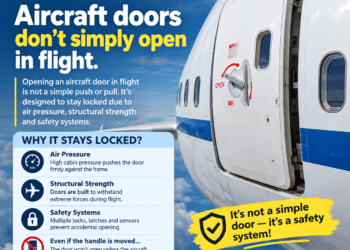
WHY DON’T AIRCRAFT DOORS SIMPLY OPEN IN FLIGHT?

September 7, 2026
Why airplane windows have tiny holes?
Blogs

Why airplane windows have tiny holes?

September 7, 2026
Why airplane windows have tiny holes?
Blogs

Why Your Ears Pop When Flying in an Airplane

September 7, 2026
How the Wings of an Airplane Generate Lift
Blogs

How the Wings of an Airplane Generate Lift

September 7, 2026

Preparing for DGCA AME exams?

Previous year papers, B1 & B2 notes and DGCA-pattern mock tests – all in one place.

Take a Mock Test DGCA Question Papers & Notes
AME QUESTION PAPER

India's first online platform for AME candidates, serving students since 2017 with quality study material for DGCA and EASA exams.

11,75,112 Global visitors
Since 2017 Serving AME students

Study Resources

  • DGCA Papers & Notes
  • Mock Tests
  • EASA Papers & Notes
  • AME Reference Books
  • RTR(A) Classes
  • Members' Results

Quick Links

  • Home
  • About Us
  • Aviation Jobs
  • Aviation News
  • Blogs
  • My Dashboard

Help & Policies

  • Contact Us
  • Terms & Conditions
  • Privacy Policy
  • Refunds & Cancellations
  • Disclaimer

Get in Touch

  • WhatsApp Support +91 75593 69412
  • Support support@amequestionpaper.in
© 2017–2026 AME QUESTION PAPER. All rights reserved. Design by AME QUESTION PAPER ❤

Ok

Create New Account!

Fill the forms below to register

All fields are required. Log In

Retrieve your password

Please enter your username or email address to reset your password.

Log In
✈
AME QUESTION PAPER Support www.amequestionpaper.in
Hi! 👋 How can we help with your DGCA Exam Preparation?
What do you need help with?
DGCA QUESTION PAPERSMOCK TESTRTR(A) CLASSESGUIDANCE
Start WhatsApp Chat WhatsApp Support: +91 75593 69412
No Result
View All Result
  • Home
  • AME
    • DGCA QUESTION PAPER & NOTES
    • MOCK TEST
    • AME REFERENCE BOOKS
    • EASA QUESTION PAPER & NOTES
  • RTR
  • JOBS
  • News
  • Blogs
  • Login
  • Sign Up

Copyright 2017-2026 © All rights Reserved. Design by AME QUESTION PAPER ❤

Insert/edit link

Enter the destination URL

Or link to existing content

    No search term specified. Showing recent items. Search or use up and down arrow keys to select an item.