✈

Welcome to AME QUESTION PAPER

Sign in to access your study materials, mock tests and more.

Login with Google

Sign in with Google. New users get an account automatically.

G Sign up with Google

New user? Create your account with Google.

Login / Sign Up with Email

✈
AME QUESTION PAPER
www.amequestionpaper.in
Skip to content
✈ India's AME Exam Preparation Platform Serving AME Students Since 2017
WhatsApp Support Contact
AME Question Paper
Home
📘 DGCA Question Papers Previous papers & short notes ⭐ Premium Study Material Premium DGCA AME modules 📚 AME Reference Books Recommended reference material 🌐 EASA Papers & Notes EASA examination resources
Mock Tests RTR(A) Jobs News Blogs
Premium Login
Login / Sign Up Home DGCA Question Papers & Notes Premium Study Material Premium Mock Tests AME Reference Books RTR(A) Aviation Jobs Aviation News Blogs

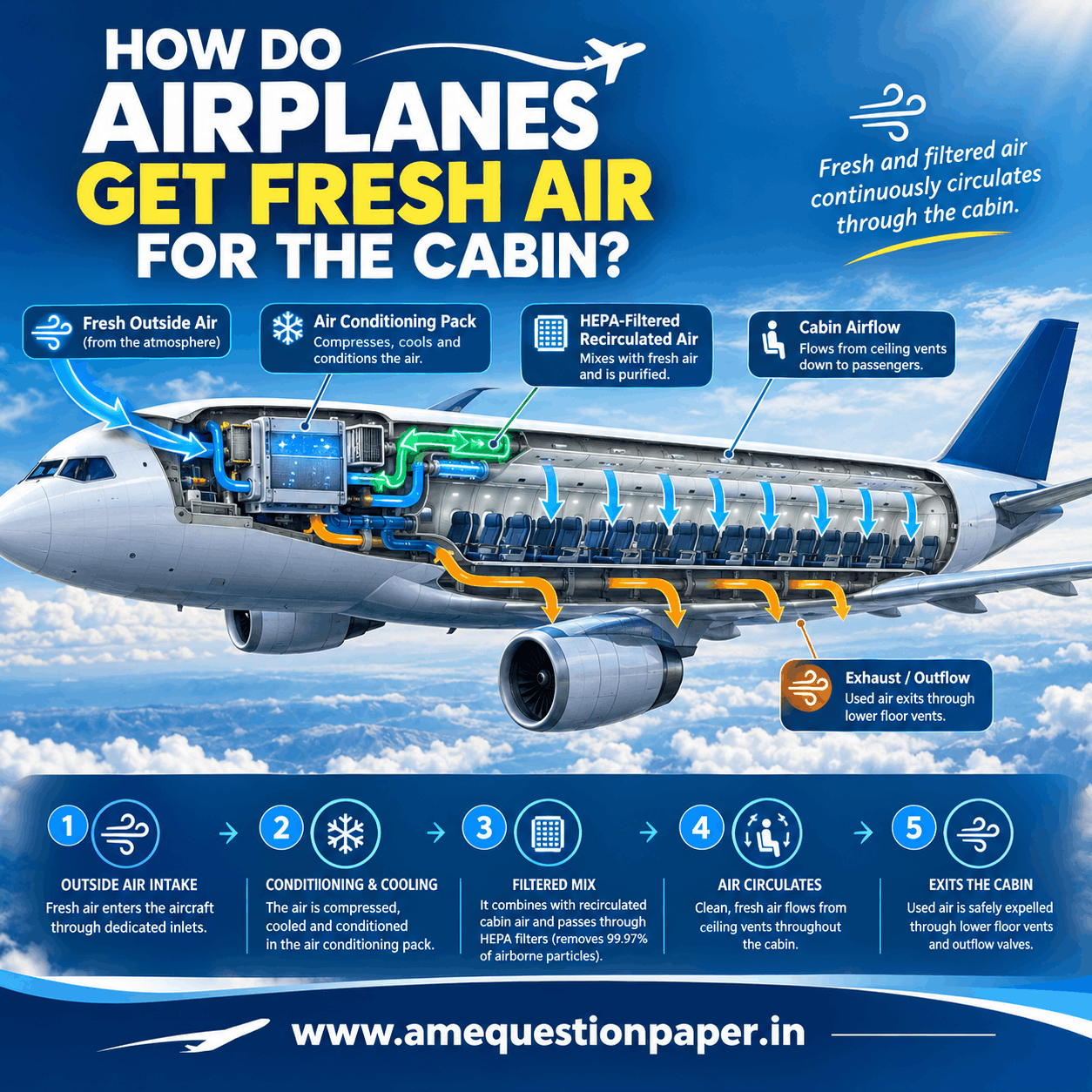
How Do Airplanes Get Fresh Air for the Cabin?

November 20, 2026
in Blogs
A A
How Do Airplanes Get Fresh Air for the Cabin?

Airplane cabins don’t consist entirely of recycled air. Depending on the type of airplane, it may only recycle about half of this air. The other half consists of fresh air. Being that cabins are pressurized — and, therefore, sealed — you might be wondering how they get fresh air. Passengers can’t open windows to allow fresh air to enter the cabin. If there’s a breach in the cabin, such as an open window, the cabin will lose pressure. So, how do airplanes can get fresh air for the cabin?

The Basics of Airplane Cabin Air

Most airplanes get fresh air from their jet engines. Like automotive engines, the jet engines used in airplanes require air. They can’t burn fuel alone to generate power. Rather, they require a combination of fuel and air. When exposed to a spark, these two elements will combust, thereby generating power that propels the airplane through the air.

When air enters an airplane’s engines, it’s compressed. Some of this air then enters the engines’ combustion chambers where it’s burned. The air that doesn’t go into the combustion chambers, however, is routed to the airplane’s cabin. The compressed fresh air travels to the airplane’s air conditioning unit where it’s cooled, after which it’s released through the vents.

Why Airplanes Use a Mixture of Fresh and Recycled Air

As previously mentioned, airplanes use a mixture of both fresh and recycled air for the cabin. They need fresh air specifically to regulate humidity levels. Airplane cabins already have dry air with a low humidity level. Research shows that most airplane cabins have a relative humidity level of about 20%. In comparison, experts recommend maintaining a humidity level of about 40% to 50% in your home.

If they only used recycled air, airplanes would have even drier cabin air with a lower humidity level. The use of fresh air adds moisture vapor to the cabin, thereby raising its humidity level. Cabins still have dry air, but the air would be much drier if it consisted entirely of recycled air. The air outside of airplanes is more humid than the cabin air.

Secondly, the use of fresh air helps to minimize airborne pollutants. Germs can spread inside airplane cabins. Although they use filters, germs can still float through the cabin. Pumping fresh air into the cabin helps to reduce the transmission of germs and other pollutants. The old air is released and replaced with fresh air.
Related Posts

AMOS APN Finder
Blogs

AMOS APN Finder

November 20, 2026
MEL Calculator
Blogs

MEL Calculator

November 20, 2026
Blogs

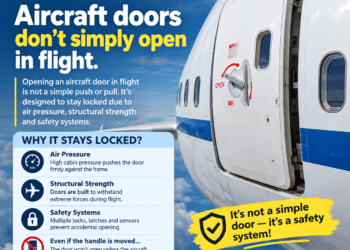
WHY DON’T AIRCRAFT DOORS SIMPLY OPEN IN FLIGHT?

November 20, 2026
Why airplane windows have tiny holes?
Blogs

Why airplane windows have tiny holes?

November 20, 2026
Why airplane windows have tiny holes?
Blogs

Why Your Ears Pop When Flying in an Airplane

November 20, 2026
How the Wings of an Airplane Generate Lift
Blogs

How the Wings of an Airplane Generate Lift

November 20, 2026

Preparing for DGCA AME exams?

Previous year papers, B1 & B2 notes and DGCA-pattern mock tests – all in one place.

Take a Mock Test DGCA Question Papers & Notes
AME QUESTION PAPER

India's first online platform for AME candidates, serving students since 2017 with quality study material for DGCA and EASA exams.

11,75,112 Global visitors
Since 2017 Serving AME students

Study Resources

  • DGCA Papers & Notes
  • Mock Tests
  • EASA Papers & Notes
  • AME Reference Books
  • RTR(A) Classes
  • Members' Results

Quick Links

  • Home
  • About Us
  • Aviation Jobs
  • Aviation News
  • Blogs
  • My Dashboard

Help & Policies

  • Contact Us
  • Terms & Conditions
  • Privacy Policy
  • Refunds & Cancellations
  • Disclaimer

Get in Touch

  • WhatsApp Support +91 75593 69412
  • Support support@amequestionpaper.in
© 2017–2026 AME QUESTION PAPER. All rights reserved. Design by AME QUESTION PAPER ❤

Ok

Create New Account!

Fill the forms below to register

All fields are required. Log In

Retrieve your password

Please enter your username or email address to reset your password.

Log In
✈
AME QUESTION PAPER Support www.amequestionpaper.in
Hi! 👋 How can we help with your DGCA Exam Preparation?
What do you need help with?
DGCA QUESTION PAPERSMOCK TESTRTR(A) CLASSESGUIDANCE
Start WhatsApp Chat WhatsApp Support: +91 75593 69412
No Result
View All Result
  • Home
  • AME
    • DGCA QUESTION PAPER & NOTES
    • MOCK TEST
    • AME REFERENCE BOOKS
    • EASA QUESTION PAPER & NOTES
  • RTR
  • JOBS
  • News
  • Blogs
  • Login
  • Sign Up

Copyright 2017-2026 © All rights Reserved. Design by AME QUESTION PAPER ❤

Insert/edit link

Enter the destination URL

Or link to existing content

    No search term specified. Showing recent items. Search or use up and down arrow keys to select an item.