✈

Welcome to AME QUESTION PAPER

Sign in to access your study materials, mock tests and more.

Login with Google

Sign in with Google. New users get an account automatically.

G Sign up with Google

New user? Create your account with Google.

Login / Sign Up with Email

✈
AME QUESTION PAPER
www.amequestionpaper.in
Skip to content
✈ India's AME Exam Preparation Platform Serving AME Students Since 2017
Premium Study Material WhatsApp Support Contact
AME Question Paper
Home
📘 DGCA Question Papers Previous papers & short notes ⭐ Premium Study Material Premium DGCA AME modules 📚 AME Reference Books Recommended reference material 🌐 EASA Papers & Notes EASA examination resources
Mock Tests RTR(A) Jobs News Blogs
⌕ Login / Sign Up
Premium Study Material
Home 📘 DGCA Question Papers & Notes ⭐ Premium Study Material 🎯 Premium Mock Tests 📚 AME Reference Books 🎙 RTR(A) 💼 Aviation Jobs 📰 Aviation News ✍ Blogs Login / Sign Up

Why Airplane Cabins Are Pressurized

May 6, 2022
in Blogs
A A
Why Airplane Cabins Are Pressurized

Whether you’re flying in a massive Airbus A380 or a smaller regional jet (RJ), it probably has a pressurized cabin. With the exception of certain military aircraft, all airplanes have a pressurized cabin. It’s an integral part of designing an aircraft. So, what’s the purpose of a pressurized cabin exactly?

How Cabins Are Pressurized

Airplane cabins are pressurized by forcing air into the cabin. Just like you pressurize a car tire by flowing air into it, airplanes do the same for the cabin. Air is pumped into the cabin, and because the cabin is sealed, the pressure increases. Normally, this pressure is created from the engines used to power the airplane. As the engines turn fuel and generate combustion, some of the air is forced into the cabin (don’t worry; it’s clean) to achieve an appropriate pressure.

Why Pressurized Cabins Are Necessary

Cabins are pressurized to create a safe and comfortable environment for pilots, crew and passengers. Most commercial airplanes fly at around 30,000 to 40,000 feet above sea level. At high altitudes such as this, the air is thinner than it is on the ground. And being that humans have evolved on land, our lungs are designed to breathe this thin air. If someone is forced to breathe the air at 30,000 feet, he or she may experience a medical condition known as hypoxia, which is characterized by lack of oxygen to the brain. By pressurizing the cabin, however, it creates a suitable environment with more oxygen, which is essential for our health and wellness.

The use a pressurized cabin is essential for creating a safe environment for passengers, but it does carry the risk of a blowout. If a window breaks or emergency door opens, everything will be sucked out as the pressure attempts to equalize. The highly pressurized air inside the cabin will travel outside of the airplane where the pressure is much lower.

Some people assume that only the cabin of an airplane is pressurized, but this isn’t necessarily true. In many cases, the entire fuselage is pressurized, including the cargo hold. This means all checked luggage and other cargo the plane is carrying is under the same pressure.

To recap, airplanes are pressurized because it protects pilot, crew and passengers from hypoxia. Airplanes are designed to pump air into the cabin to mimic the 14.7 pounds per square (PSI) of pressure that’s found at sea level.


Related Posts

AMOS APN Finder
Blogs

AMOS APN Finder

October 16, 2026
MEL Calculator
Blogs

MEL Calculator

October 16, 2026
Blogs

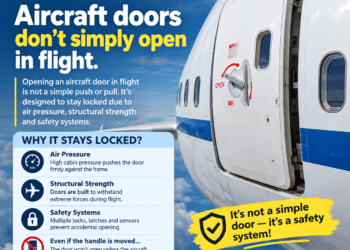
WHY DON’T AIRCRAFT DOORS SIMPLY OPEN IN FLIGHT?

September 7, 2026
Why airplane windows have tiny holes?
Blogs

Why airplane windows have tiny holes?

September 7, 2026
Why airplane windows have tiny holes?
Blogs

Why Your Ears Pop When Flying in an Airplane

September 7, 2026
How the Wings of an Airplane Generate Lift
Blogs

How the Wings of an Airplane Generate Lift

September 7, 2026

Preparing for DGCA AME exams?

Previous year papers, B1 & B2 notes and DGCA-pattern mock tests – all in one place.

Take a Mock Test DGCA Question Papers & Notes
AME QUESTION PAPER

India's first online platform for AME candidates, serving students since 2017 with quality study material for DGCA and EASA exams.

11,75,112 Global visitors
Since 2017 Serving AME students

Study Resources

  • DGCA Papers & Notes
  • Mock Tests
  • EASA Papers & Notes
  • AME Reference Books
  • RTR(A) Classes
  • Members' Results

Quick Links

  • Home
  • About Us
  • Aviation Jobs
  • Aviation News
  • Blogs
  • My Dashboard

Help & Policies

  • Contact Us
  • Terms & Conditions
  • Privacy Policy
  • Refunds & Cancellations
  • Disclaimer

Get in Touch

  • WhatsApp Support +91 75593 69412
  • Support support@amequestionpaper.in
© 2017–2026 AME QUESTION PAPER. All rights reserved. Design by AME QUESTION PAPER ❤

Ok

Create New Account!

Fill the forms below to register

All fields are required. Log In

Retrieve your password

Please enter your username or email address to reset your password.

Log In
✈
AME QUESTION PAPER Support www.amequestionpaper.in
Hi! 👋 How can we help with your DGCA Exam Preparation?
What do you need help with?
DGCA QUESTION PAPERSMOCK TESTRTR(A) CLASSESGUIDANCE
Start WhatsApp Chat WhatsApp Support: +91 75593 69412
No Result
View All Result
  • Home
  • AME
    • DGCA QUESTION PAPER & NOTES
    • MOCK TEST
    • AME REFERENCE BOOKS
    • EASA QUESTION PAPER & NOTES
  • RTR
  • JOBS
  • News
  • Blogs
  • Login
  • Sign Up

Copyright 2017-2026 © All rights Reserved. Design by AME QUESTION PAPER ❤

Insert/edit link

Enter the destination URL

Or link to existing content

    No search term specified. Showing recent items. Search or use up and down arrow keys to select an item.