✈

Welcome to AME QUESTION PAPER

Sign in to access your study materials, mock tests and more.

Login with Google

Sign in with Google. New users get an account automatically.

G Sign up with Google

New user? Create your account with Google.

Login / Sign Up with Email

✈
AME QUESTION PAPER
www.amequestionpaper.in
Skip to content
✈ India's AME Exam Preparation Platform Serving AME Students Since 2017
Premium Study Material WhatsApp Support Contact
AME Question Paper
Home
📘 DGCA Question Papers Previous papers & short notes ⭐ Premium Study Material Premium DGCA AME modules 📚 AME Reference Books Recommended reference material 🌐 EASA Papers & Notes EASA examination resources
Mock Tests RTR(A) Jobs News Blogs
⌕ Login / Sign Up
Premium Study Material
Home 📘 DGCA Question Papers & Notes ⭐ Premium Study Material 🎯 Premium Mock Tests 📚 AME Reference Books 🎙 RTR(A) 💼 Aviation Jobs 📰 Aviation News ✍ Blogs Login / Sign Up

Why Planes Don’t Fly In A Straight Line On A Map

May 6, 2022
in Blogs
A A

The next time you fly, whether domestic or international, take a look a look at the flight map. You may discover that your flight’s trajectory isn’t a straight line. Rather, it’s an arc that either angles up (North) or down (South) before changing direction halfway through. Also known as a great circle, this arc leaves many passengers confused. After all, conventional wisdom should lead you to believe that the shortest distance between two places is a straight line. So, why do plans travel in an arc instead of a straight line?

The Earth Is 3D, Maps are 2D

The reason planes travel in an arc is because Earth is three dimensional and maps are two dimensional. If you made a straight line between two locations, such as New York City and Paris, on a spherical, three-dimensional globe and then flattened globe into a two-dimensional map, the once-straight route would then be an arc. As a result, the shortest path between two locations is in fact an arc, thus the reason airlines prefer this trajectory.

Any by choosing the shortest possible flight trajectory, airlines save money in several ways. First, it takes less fuel to fly a short path rather than a lone one. Second, airlines pay less in employee expenses. And third, airlines are able to sell more tickets when they perform shorter flights. These are just a few reasons that airlines typically choose the shortest flight path, which is an arc.

Other Factors

Of course, other factors can affect a plane’s flight path, thereby forcing it to fly in a direction that isn’t a straight line or even a perfectly arced line. According to Smithsonian Magazine, there are more than 5,000 commercial planes flying in U.S. skies at any moment — and that’s not accounting for international or private flights. With so many planes in the air, airlines are often forced to change their trajectory to avoid midair collisions. It’s important to note, however, that trajectory changes due to air traffic such as this are small and insignificant when viewed on a map.

In Conclusion

It’s no secret that airlines prefer the shortest flight paths to save money and improve efficiency. But seeing an arced route can leave passengers confused. As revealed here, though, an arc — when displayed on a flat map — is the shortest distance between two locations, so it only makes sense for airlines to use them.

Related Posts

AMOS APN Finder
Blogs

AMOS APN Finder

October 16, 2026
MEL Calculator
Blogs

MEL Calculator

October 16, 2026
Blogs

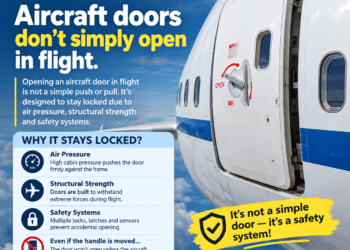
WHY DON’T AIRCRAFT DOORS SIMPLY OPEN IN FLIGHT?

September 7, 2026
Why airplane windows have tiny holes?
Blogs

Why airplane windows have tiny holes?

September 7, 2026
Why airplane windows have tiny holes?
Blogs

Why Your Ears Pop When Flying in an Airplane

September 7, 2026
How the Wings of an Airplane Generate Lift
Blogs

How the Wings of an Airplane Generate Lift

September 7, 2026

Preparing for DGCA AME exams?

Previous year papers, B1 & B2 notes and DGCA-pattern mock tests – all in one place.

Take a Mock Test DGCA Question Papers & Notes
AME QUESTION PAPER

India's first online platform for AME candidates, serving students since 2017 with quality study material for DGCA and EASA exams.

11,75,112 Global visitors
Since 2017 Serving AME students

Study Resources

  • DGCA Papers & Notes
  • Mock Tests
  • EASA Papers & Notes
  • AME Reference Books
  • RTR(A) Classes
  • Members' Results

Quick Links

  • Home
  • About Us
  • Aviation Jobs
  • Aviation News
  • Blogs
  • My Dashboard

Help & Policies

  • Contact Us
  • Terms & Conditions
  • Privacy Policy
  • Refunds & Cancellations
  • Disclaimer

Get in Touch

  • WhatsApp Support +91 75593 69412
  • Support support@amequestionpaper.in
© 2017–2026 AME QUESTION PAPER. All rights reserved. Design by AME QUESTION PAPER ❤

Ok

Create New Account!

Fill the forms below to register

All fields are required. Log In

Retrieve your password

Please enter your username or email address to reset your password.

Log In
✈
AME QUESTION PAPER Support www.amequestionpaper.in
Hi! 👋 How can we help with your DGCA Exam Preparation?
What do you need help with?
DGCA QUESTION PAPERSMOCK TESTRTR(A) CLASSESGUIDANCE
Start WhatsApp Chat WhatsApp Support: +91 75593 69412
No Result
View All Result
  • Home
  • AME
    • DGCA QUESTION PAPER & NOTES
    • MOCK TEST
    • AME REFERENCE BOOKS
    • EASA QUESTION PAPER & NOTES
  • RTR
  • JOBS
  • News
  • Blogs
  • Login
  • Sign Up

Copyright 2017-2026 © All rights Reserved. Design by AME QUESTION PAPER ❤

Insert/edit link

Enter the destination URL

Or link to existing content

    No search term specified. Showing recent items. Search or use up and down arrow keys to select an item.